
As the urgency to combat climate change increases, businesses around the world are committing to decarbonisation strategies that align with scientific consensus. One of the most trusted frameworks guiding corporate climate action is the Science Based Targets initiative (SBTi). SBTi has formed a pathway for companies to reach net zero by 2050 at the latest.
Net zero means bringing greenhouse gas emissions as close to zero as possible, while offsetting any remaining emissions through carbon removal solutions. It’s a vital step in tackling climate change and securing a sustainable future for our planet.
In this article, we break down what an SBTi Net-Zero Strategy entails and how your organisation can develop one – including the role of offsetting in reaching climate goals.
What is the SBTi?
The SBTi is a partnership between CDP, the UN Global Compact, World Resources Institute (WRI), and WWF. It helps companies set emission reduction targets consistent with limiting global warming to 1.5°C, in line with the Paris Agreement.
In October 2021, the SBTi launched the world’s first Net-Zero Standard, establishing a clear, science-based definition of net zero for companies and the criteria to validate corporate targets.
What does an SBTi Net-Zero Strategy include?
A company’s SBTi Net-Zero Strategy consists of two core pillars:
Note that you can do both, or only one.
1. Near-term Science Based Targets
These emission reduction goals are set 5-10 years in the future from when the target is set, they can cover Scope 1, 2, and 3 emissions, ideally aligned with a 1.5°C pathway. The near-term targets form an essential part of a company’s net-zero roadmap and require a major reduction in emissions over the next ten years.
2. Long-term net-zero targets
By 2050 (or earlier), companies commit to achieve a state of near-complete decarbonisation, reducing emissions by at least 90–95% across all scopes. The residual emissions that are left once a company has reached 90-95%, can be neutralised using carbon removals.
How to set an SBTi Net-Zero Strategy
Here’s a high-level guide to developing and validating an SBTi Net-Zero Strategy:
Step 1: Measure and map emissions to set a baseline year
Create a comprehensive GHG inventory that includes:
- Scope 1 (direct emissions)
- Scope 2 (indirect emissions from purchased electricity)
- Scope 3 (all other indirect emissions, e.g., supply chain, business travel)
This forms the baseline against which future reductions are measured. Choose a year that is representative of your business and where you can gather quality data.
Step 2: Set near-term Science Based Targets
These targets should:
- Have a timeframe of 5–10 years from the day of submission
- Cover all of Scope 1 and 2 emissions (An allowance of 5% can be applied in specific cases)
- Include Scope 3 if it accounts for more than 40% of total emissions, and if so you need to include at least 67%.
Use SBTi and sector specific guidance to formulate your near-term goals.
Step 3: Define a long-term net-zero target
Commit to reducing at least 90% of emissions across all scopes by 2050.
Step 4: Develop a transition/decarbonisation plan
Map out the operational, technological, and procurement changes needed to reach targets. Examples include:
- Electrifying transport fleets
- Switching to renewable energy
- Engaging suppliers on emissions reductions
Step 5: Make a plan for offsetting
Offsetting plays a role in addressing unabated and residual emissions. Though it is important to emphasise that offsets shall not be used as a substitute for decarbonisation. When it comes to carbon credits, the SBTi requires:
- Use of high-quality carbon removals (e.g., reforestation, direct air capture)
- Differentiation between avoidance credits and removal credits
- Credits to be chosen by criteria such as additionality, scalability and co-benefits
Step 6: Submit targets to the SBTi for validation
Once set, targets must be submitted for official SBTi validation. This confirms alignment with climate science and enhances credibility with stakeholders.
Why offsetting is a small, but important, piece of the puzzle
A core principle of the SBTi Net-Zero Standard is clear: emissions reductions must come first. Offsetting, even with the highest quality carbon removals, is not a shortcut, but a way to address the emissions that can’t be eliminated.
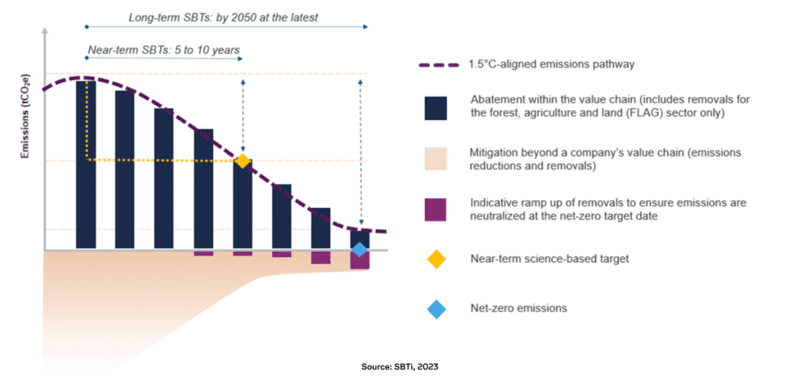
To guide companies on this front, the SBTi outlines two distinct approaches to offsetting, illustrated in the diagram below.
The first is carbon removals for residual emissions. The 5–10% of unavoidable greenhouse gases that remain after a company has reduced its emissions by 90–95% by 2050. These are shown as light blue in the diagram and must be neutralised with permanent, verifiable carbon removal solutions.
The second approach is known as Beyond Value Chain Mitigation (BVCM). This is a recommended, but not required, strategy that encourages companies to go further by addressing unabated emissions outside their direct value chain. BVCM typically involves the use of avoidance credits to mitigate broader climate impacts while progressing toward net zero.
Final thoughts
The SBTi Net-Zero Strategy sets the benchmark for credible climate action. It offers a rigorous, science-backed path to decarbonisation, with offsetting being an important part of the bigger picture.
At Atmoz, we help organisations turn these principles into practice. Our climate analysts can also support you in designing and submitting SBTi targets and develop transition plans. In addition we also support with emissions calculations using our Carbon accounting platform and carbon offsetting, helping you design an optimized portfolio of carbon credits. If you’re ready to align with the SBTi, Atmoz is here to support every step of the way.


