

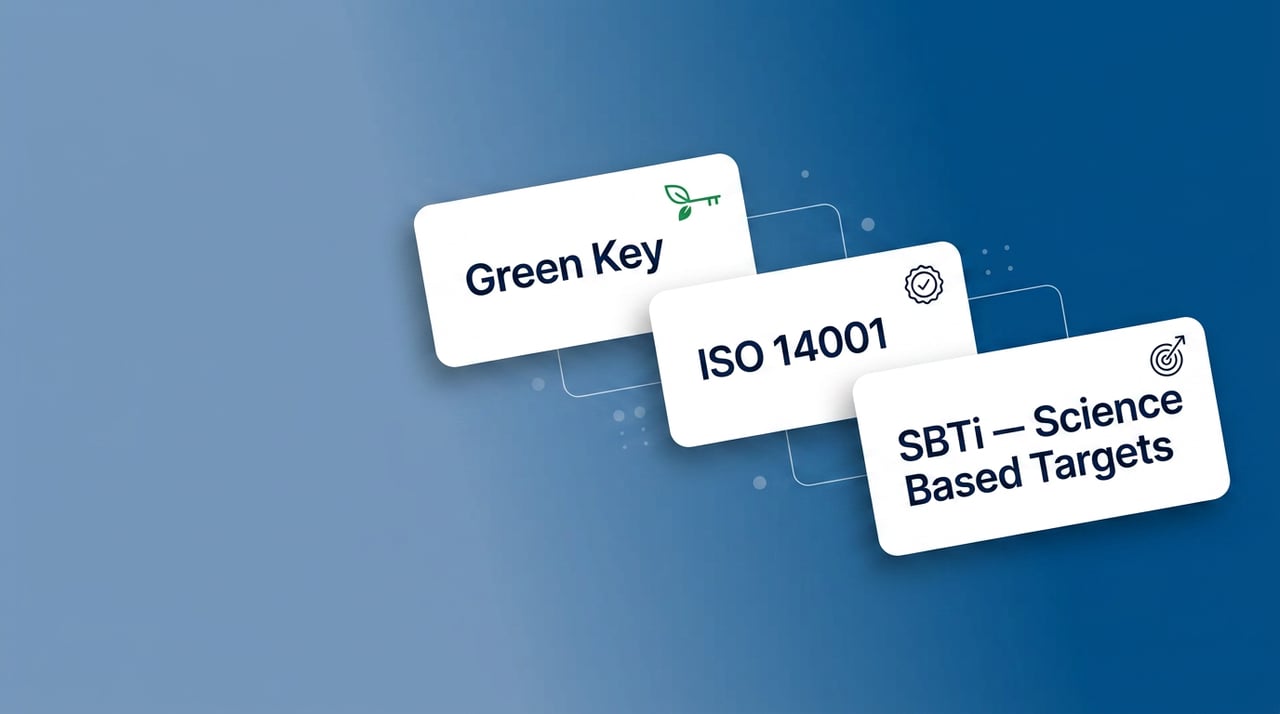
Key considerations for selecting sustainability certifications
When deciding which certifications or frameworks to pursue, consider the following:
- Industry relevance: Does the certification align with your sector’s specific sustainability challenges?
- Customer expectations: Are your customers or stakeholders demanding compliance with certain standards?
- Regulatory requirements: Are there legal or regulatory incentives for obtaining a particular certification?
- Company goals: Does the certification align with your overarching sustainability and business objectives?
- Resource availability: Do you have the capacity (time, expertise, and budget) to meet the requirements?
Overview of key certifications and frameworks
Green Key certification
An international eco-label specifically for the hospitality sector, awarded to establishments that meet stringent environmental standards.
- Hotels, hostels, campsites, and other hospitality businesses committed to sustainable operations.
- Organisations aiming to attract environmentally conscious travelers.
- Improves resource efficiency and reduces environmental impact.
- Enhances brand reputation in the growing eco-tourism market.
- Encourages employee and guest engagement in sustainability efforts.
- Are we in the hospitality sector and looking to implement sustainable practices?
- Do we want to distinguish ourselves as an eco-friendly destination?
ISO 14001 certification
A globally recognised standard for environmental management systems (EMS). It helps businesses manage environmental responsibilities in a systematic way.
- Companies looking to enhance operational efficiency and minimise environmental impact.
- Businesses aiming for continuous improvement in environmental performance.
- Demonstrates commitment to environmental responsibility.
- Can help meet legal requirements and reduce waste.
- Builds trust with environmentally conscious customers.
- Do we have significant environmental aspects to manage (e.g., waste, emissions, energy use)?
- Do we want to implement a structured approach to environmental management?
Science Based Targets initiative (SBTi)
A framework for setting greenhouse gas (GHG) emissions reduction targets in line with climate science to limit global warming to 1.5°C.
- Companies seeking to align with global climate goals.
- Organisations aiming to lead in climate action within their industry.
- Positions your company as a leader in climate responsibility.
- Provides credibility and transparency for GHG reduction efforts.
- Helps attract investors prioritising sustainability.
- Do we have the data and resources to measure and reduce GHG emissions?
- Are we committed to ambitious, science-based climate targets?
CDP
A platform for disclosing environmental impact data on climate change, water security, and deforestation. CDP scores reflect transparency and performance.
- Companies seeking to showcase transparency in environmental reporting.
- Businesses responding to investor, customer, or regulatory demands for disclosure.
- Enhances brand reputation through credible disclosure.
- Supports risk management by identifying environmental risks.
- Aligns with other reporting frameworks like TCFD and GRI.
- Are our investors or stakeholders requesting environmental disclosures?
- Do we want to benchmark our performance against industry peers?
UN Global Compact’s Agenda 2030
A voluntary initiative based on ten principles related to human rights, labour, environment, and anti-corruption. It encourages alignment with the Sustainable Development Goals (SDGs).
- Companies committed to holistic sustainability and corporate responsibility.
- Organisations aligning their strategy with global development priorities.
- Provides a broad framework for sustainable development.
- Enhances corporate social responsibility (CSR) initiatives.
- Strengthens global partnerships and stakeholder engagement.
- Do we want to contribute to the broader SDGs?
- Are we prepared to commit to transparent reporting and continuous improvement?
How to prioritise
- Assess stakeholder expectations: Consult with customers, investors, and employees to understand their priorities.
- Map against your sustainability goals: Identify certifications that best align with your specific objectives, such as emissions reduction or responsible sourcing.
- Evaluate resources: Ensure you have the capacity to meet the certification’s requirements.
- Start small: Begin with one certification or framework and expand as your sustainability strategy matures.
By carefully selecting certifications and frameworks, your business can build credibility, enhance operational efficiency, and contribute meaningfully to a sustainable future.
Measuring your emissions is the essential first step towards certifications and using software to help will not only simplify the process but also ensure success.
Fler insikter

A day in the life of our engineers
Agents write the code. Engineers own the system. A look at the engineering work that moves upstream: task decomposition, code interrogation, verification, and the constraints that make high-volume agent execution reliable.
We ship every Friday (we didn't always)
Part 2 of the Atmoz Build Series: how the rebuild actually runs, from six-week foundation cycles to one-week sprints, and why 165 working versions of the platform exist.
Inside the rebuild: how we're rethinking carbon intelligence for the AI era
Atmoz paused a growing carbon data platform and rebuilt it from ground zero. Part 1 of the Build Series explains the first-principles reasoning behind the decision, and where AI actually enters the story.